Got a question about cooking in your slow cooker? Want to know what slow cooker to buy? Check out our extensive Crock-Pot FAQ’s for the answers!
Readers send us questions via email and social media all the time and so we thought we would compile some of more frequently asked questions they ask us and put them all together on one page so that it will hopefully help everyone out.
If you have a question and it is not answered here please feel free to shoot us an email and we will get back with you as soon as possible…
Crock-Pot FAQ’s
Cooking in a crock-pot is safe. Slow cookers reach a simmer temperature of 209°F, that along with the cooking in a moist environment over a long period of time safely kills common bacteria such as E. coli, salmonella and botulism. Be sure to follow the cooking times for the recipe you are following to be sure to cook your foods, especially meats for the required times.
There is no difference. The term “slow cooker” is a generic term for the name brand “Crock-Pot”. Crock-Pot is a registered brand of slow cookers owned by the Rival parent company. And any other brand is just called a slow cooker.
Between the entire Crock-Pot Ladies team we have several slow cookers in all different shapes and sizes. From small dip sized crock-pots to casserole crock-pots and everything in between. However our go to Crock-Pot size is a nice oval shaped 6 quart crock-pot with programmable settings is our absolutely favorite. We like this size because it holds enough to feed our families which range in size from 4 to 8 people, and the oval size fits pot roasts, whole chickens and other longer cuts of meat better than a round slow cooker.
Both HIGH and LOW stabilize at the same temperature, it is just a matter of how long it takes to reach the simmer point. Once food reaches the simmer point, total cook time is dependent on cut and weight of meat to reach the point of maximum flavor and texture potential. (Most dishes can be prepared on either HIGH or LOW.
The typical time for slow cookers to reach the simmer point (209°F) is 7 to 8 hours on LOW and 3 to 4 hours on HIGH. These times however are approximate as different slow cookers will come to temperature slightly differently.
Yes you can. Below is a conversion chart to show you the comparative cook times for HIGH and LOW.
Note: It is not recommended to convert recipes with cook times less than 7 to 8 hours on LOW or 3 to 4 hours on HIGH.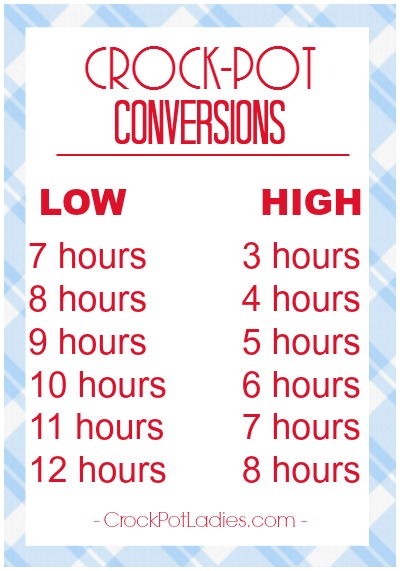
Yes we do!
Pork Butt Roast, 6 to 7 Lbs. – 9 1/2 hours on LOW or 7 1/2 hours on HIGH.
Pork Loin, 3 to 4 Lbs. – 6 hours on LOW or 5 hours on HIGH.
Whole Chicken, 6 lbs. – 7 1/2 hours on LOW or 6 1/4 hours on HIGH.
Bone-in Turkey Breasts, 6 lbs. – 7 1/2 hours on LOW or 6 1/4 hours on HIGH.
Beef Roast, 3 to 4 Lbs. – 8 hours on LOW or 5 3/4 hours on HIGH.
Stew Meat, 3 Lbs. – 6 hours on LOW or 4 3/4 hours on HIGH.
A slow cooker should be at least 1/2 full to 3/4 full for best results.
Slow cookers have very little evaporation. When converting a recipe designed for the stove top remember that your final product may be thicker, adding additional water during or at the end of cooking will help thin it out.
For most recipes you do not need to stir while cooking. In fact opening the lid to stir decreases the heat inside your slow cooker and thus increases the cooking time. However there are a few recipes that do call for opening and stirring and thus, they have been adjusted for the additional cooking time. So, unless your recipe calls for stirring, don’t. And when you do have a recipe that calls for stirring while cooking, open the lid, give it a quick stir and then close the lid quickly to prevent too much heat loss.
We don’t recommend reheating foods in your crock-pot. However most ceramic inserts that come with most slow cookers are oven and microwave safe. Please read your instruction manual that came with your slow cooker to see if the crock can go in the microwave or oven.
We suggest that you follow the recipe if it calls for pre-browning then go ahead and brown it up. While this is an added step it is usually included to create a more flavorful product and to get rid of excess fat that may alter the flavor of the end result of the the dish.
With recipes that call for ground beef, turkey, chicken or pork (with the exception of some recipes such as meatloaf an meatballs) you will want to cook the meat on the stove-top fully before adding it to the slow cooker.
Most modern crock-pots are designed to be left cooking away on the counter-top unattended. To ensure that your slow cooker is safe while cooking while unattended place your slow cooker on a clean and flat surface. Make sure that nothing is touching your crock-pot an tuck the cord up and out of the way so that it is not angling off the counter. If you have curious pets that might be tempted to investigate what’s cooking while you are not home it may be wise to make sure the pets do not have access to the kitchen.
Always fill the stoneware 1/2 to 3/4 full to conform to recommended cook times (with the exception of certain cakes and custards. Also, if a time range is given in a recipe always cook for the shortest amount of time given, check your dish, and only then cook longer if needed.
If your power was out for less than 1 hour your food is probably safe to resume cooking and to eat. However if your power was out for more than an hour or you don’t know how long you were without power it is better to be safe than sorry and we do not suggest that you attempt to eat it.
Remember, when it doubt, throw it out!
Most recipes require that you cook with the lid on. Unless the recipe calls for it leave the lid on the entire cooking time, especially during the first 2 hours.
In most cases you can, however you will need to adjust the cooking time to compensate for the frozen meat. Allow an additional 4-6 hours on LOW or 2 hours on HIGH when using frozen meat. Do not place frozen meat inside a dry pre-heated crock-pot as the quick change in temperature can crack your crock
Pasta is best cooked in rapidly boiling water. It is best to cook pasta just until tender and then add to the stoneware during the last 30 minutes of cooking.
The stoneware cannot withstand the extreme direct heat and will break if placed on a stove top burner. You may use the stoneware in the microwave or oven. However, the tempered glass lid is not suitable for microwave or oven use. We always suggest that you read your specific slow cooker’s user manual to be sure your slow cooker insert is microwave safe.
Most modern stoneware crock-pot inserts (the actual crock part of your slow cooker) can be used in the microwave. Keep in mind however that the lid is usually not microwave safe and never put the actual heating element in the microwave! If you are in doubt please refer to the owners manual to the specific crock-pot you own.
This will depend partially on the number of people you are cooking for and partially on the type of cooking you are doing.
– For singles a 1 – 1 1/2 quart is ideal.
– For a couple a 2 1/2- 3 1/2 quart is perfect.
– For a family of 3 to 4 choose a 3 1/2 – 4 1/2 quart.
– For families of 4 to 5 choose a 4 1/2 – 5 quart unit.
– For feeding 6 or more people a 6 quart is the best option.
Of course a larger size is a great choice if you want to have leftovers to freeze and serve later. Most roasts also fit better in a 5 quart or larger unit.
You sure can! Some recipes even call for wrapping meat and other ingredients in foil and then placing in the stoneware for cooking. It is also fine to place ingredients in baking bags, place in stoneware, cook and then lift the bag our of the stoneware for serving.
We love em! Anything that helps clean up time is a winner in our book. Buy them!
There is also a new reusable BPA free silicon slow cooker liner that we love too. You can read our review on it HERE or purchase one for yourself HERE.
This is probably happening because there is too much water in your recipe. One half to one cup of liquid is sufficient for most recipes that do not call for rice. Also some meats, like chicken are processed with added water, this added water or liquid cooks out and often can make your dishes more watery than you like. To avoid be sure not to add too much liquid and look for chicken and other meats without added water.
Add raw seafood 30 minutes to 1 hour before the cooking is finished. Add pre-cooked seafood a few minutes before the end of cooking.
Suggested reading: Tips For Cleaning Your Crock-Pot
We have provided the nutritional information for most of our recipes here at Crock-Pot Ladies. If you find a recipe that we have not calculated the nutritional information yet you can use a service like MyFitnessPal to calculate it yourself.
While we are working on updating and adding the nutritional information to all of our older recipes we are also working on noting if those recipes meet special diet needs where possible. You can find all of our special diet recipes at the following links:
– Gluten Free Crock-Pot Recipes
– High Fiber Crock-Pot Recipes
– Low Calorie Crock-Pot Recipes
– Low Carb Crock-Pot Recipes
– Low Cholesterol Crock-Pot Recipes
– Low Fat Crock-Pot Recipes
– Low Sodium Crock-Pot Recipes
– Low Sugar Crock-Pot Recipes
– Paleo Crock-Pot Recipes
– Vegan Crock-Pot Recipes
– Vegetarian Crock-Pot Recipes
– Weight Watchers Crock-Pot Recipes
Our goal is to do our very best to give clear instructions for our recipes. However, without being in the kitchen with you we just don’t know what might have gone wrong. One of the most common reasons for a recipe not coming out correctly are:
Different slow cooker brands cook at different temperature.
Older crock-pots tend to cook lower and slower than newer models. And some brands just run hotter or colder when they cook.
Substituting ingredients or not following the recipe correctly.
Not cooking the proper time and temperature setting as instructed in the recipe.
Water content of food. Sometimes the water content in certain meats and vegetables can really vary and this may cause a recipe to turn out watery or dryer than it should.
We have tried our very best to include the size of crock-pot we have used while testing and creating our recipes. However there may be some recipes that do not include this information yet. If you spot a recipe that does not list the crock-pot size please leave a comment on the recipe or contact us and let us know.
Most of our recipes are cooked in a 6 quart crock-pot, but that does not mean that they cannot be adapted to fit slightly smaller or larger slow cookers.
To make it easy to find the recipes that DO have the Crock-Pot size listed you can click on one of the following links:
– 2.5 Quart Crock-Pot Recipes
– 3 Quart Crock-Pot Recipes
– 3.5 Quart Crock-Pot Recipes
– 4 Quart Crock-Pot Recipes
– 4.5 Quart Crock-Pot Recipes
– 5 Quart Crock-Pot Recipes
– 5.5 Quart Crock-Pot Recipes
– 6 Quart Crock-Pot Recipes
– 6.5 Quart Crock-Pot Recipes
– 7 Quart Crock-Pot Recipes
Also
– 3.5 Quart Casserole Crock-Pot Recipes
Yes you can, in fact we do it all the time ourselves on days we know that we are going to be extra busy. Even a teenager can be instructed to get the crock out of the refrigerator, put it on the base and turn it on to cook in the morning before they head off to school!
Crock-Pot Ladies Store FAQ’s
A link to our online store can be found in the top toolbar of our website. Or you can just click the following link to be taken directly to it: Crock-Pot Ladies Store
At this time we only offer digital products for sale in our store. Because of the nature of digital products we are unable to offer a refund on purchases of digital good.
In the near future we plan on adding physical products to our online store and we will update our refund policy when that happens to reflect physical products.
Yes, in fact we try to have at least one promotion going on each month with some sort of discount. You can find our current promotions at the following link: Deals & Discounts
Our store accepts payments through PayPal. With PayPal you have the option to pay for your order with your PayPal balance or use a credit or debit card.
Crock-Pot Ladies Website FAQ’s
Recipes – no. We do not allow republications of our recipes in part or in full on other websites or blogs without our prior written consent. When people republish our recipes on their websites or blogs it negatively affects how Crock-Pot Ladies gets displayed in search results. Additionally, there are some copyright issues there as our recipes belong to us and republishing our recipes elseware without our consent is in violation of our copyright. This also applies to publishing our entire recipes on social media.
Photos – you have our permission to publish 1 to 2 photos of any given recipe on your website and blog provided that our watermark is not intentionally cropped off the photo and that you give two links back to us. The first link should point to the recipe on the blog and the second link should point back to our homepage at crockpotladies.com If you need photos in a different size than what is displayed on our website please feel free to contact us to inquire and we will try our best to accommodate your needs if at all possible.
We have a lot of recipes here on the blog and if you are looking for a particular recipe we invite you to use either the basic search located near the top right of our blog. Additionally our Crock-Pot Recipe Index page contains an advanced search feature where you can narrow down your results by identifying more search options.